
Working on Your RV as a hobby
A hobby is something you enjoy doing -- golf, fishing, etc. For most people working on their RV doesn't fit into this category.
I heard a fellow RVer recently say, "I'm not very good with tools." My thought is that if you're going own an RV, you better get good with tools. I don't mean you have to be an expert, but when you're paying an RV shop $125 an hour to do routine things, the bill can add up in a hurry.
One of the best ways to learn how to fix things on your RV is to hire a mobile RV tech when you have a problem that would normally require you to take your rig to an RV shop. One of the big advantages of using a mobile RV tech is that you get to watch what he's doing and you can ask questions.
In other words, you learn more about your rig and how to fix things. When you take your RV to a repair place, you don't get to go back in the shop and watch.
You can ask the RV tech a lot of questions. Where is the water pump? How do I change the fuel filter for the generator? How to change the engine air filter? There are some things that I take my motorhome to an RV shop to get repaired, but more and more I'm learning (and enjoying) doing a lot of things myself.
For example, today I had a problem with my water pump
Maybe it wasn't a problem with the water pump. The pump would turn on and I could hear it making the pulsating sound when I flipped the switch, but I couldn't get any water when I wasn't connected to city water.
It had been working fine for three years. I had not checked it in almost a month, but I was planning on doing some boondocking -- actually I'm planning on staying in a Walmart parking lot overnight in a few days, so I decided to check it. I'm glad I did.
I got the manual out and read what little it had to say about the water system, and then I decided to dig in and see what I could find out or fix.
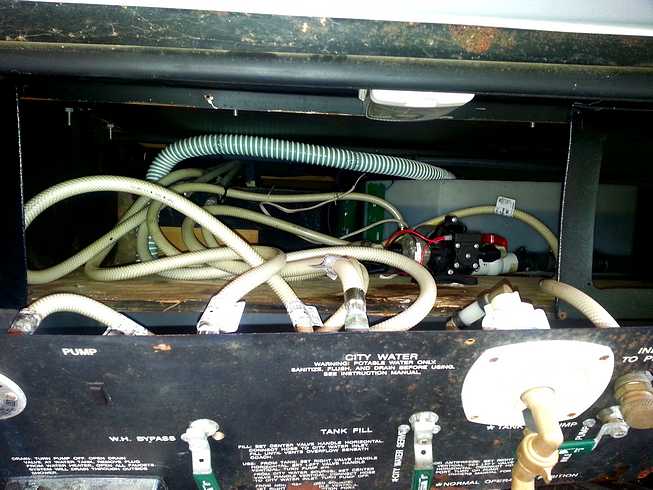
As you can see in the above picture, when I took the six screws out of the water manifold and dropped it down so I could look at the pump, it looked like a rat's nest in there with all of the hoses. The good news was that I didn't see any leaks.
I disconnected what I thought was the hose on the output side of the pump, but it was the wrong one. I screwed it back on, and unscrewed the hose on the other side.
Then I went inside the RV and flipped the switch to turn the pump on. When I went back outside, water was gushing out of the pump. That was good news. I rushed back in and turned the pump off.
Then I screwed the hose back onto the pump, operated all of the valve handles and went back inside to check the system again, and low and behold, everything worked fine. I tried it a couple of times with city water connected and with it disconnected. I had water flowing either way as long as I had the pump turned on when the city water was disconnected.
I'm not sure what the problem was. Either the pump was vapor locked, or maybe I didn't have the valve handles in the correct position, but all that matters is that I now have it working, and I didn't have to pay an RV tech $125 or more -- and I know a lot more about how my water system works.
I'm not sure that I can say that I enjoyed the process, but I am glad that I know where my water pump is, how to get to it, and I know a little more about how my water system works.
There's an almost never ending list of things you can do to your RV
- Are there any light bulbs that need replacing?
- Is changing to LEDs something that's on your list?
- Routine things like checking fluids and running the generator, replacing windshield wipers.
- Modifications? There's a never-ending list of things you can change or add to your RV -- remote tire sensors, external tank sensors, a flat screen TV, a pure sine wave inverter, extra batteries, and the list goes on. These things cost money but save two hours of having your rig in the shop and that gives you $250 back in the budget to buy toys and gadgets.
- Oil or grease everything that moves -- steps, slide-out gears, all hinges (inside and outside), gears on the crank-up TV antenna (a little silicon spray or grease makes it go up and down so much easier).
- Clean out and organize your storage bins. Put everything in its place and throw away all of the junk.
- Check for water leaks. A moisture meter works wonders for this.
- Check and clean your battery post and cable connections.
- Sand and paint the rusty parts of the chassis.
- While you're under the RV checking for rust, look for wires that are rubbing against something and not protected. A broken or shorted wire can be a hard problem to find. Tie wrap and tape loose wires and you can prevent some problems.
- Keep your roof clean and keep an eye on all of the joints where a leak might develop. Use chaulking and/or Eternabond tape to prevent leaks.
- And of course, you can always do more waxing and polishing.
One thing not to do
Don't put the stuff on your tires that makes them shine. Most of these have chemicals that cause the tires to dry out. At the price of tires, you sure don't want to do anything that will shorten the life of your tires. Just keep the tires clean with soap and water.
Take advantage of expert information
RVs are made from a lot of parts from different manufacturers. When you have a problem with something -- microwave, generator, toilet, backup camera, or whatever -- start by seeing if you have a manual and, if not, can you find a manual online? Consider calling tech support at the factory. Also, you can find YouTube videos showing how to do a lot of RV repair work.Bottom Line: Whether it's work or play depends mostly on your attitude. Take pride in having a well-maintained rig, and the work will be a lot more enjoyable. RVs can last forever if you take care of them. I know people who have 50 and 60-year-old rigs that are in better condition (both mechanically and cosmetically) than most rigs on the road. Yours can be one of them.