
How to protect your most important contacts
We all have contacts on our computers and on our cell phones. Many of the contacts you have are close friends and you would hate to lose them.
Of course, some of your contacts are a lot more important than others.
When you're RVing, there are other types of contacts that are important too
I'm talking about the hundreds of electrical contacts throughout your RV. We usually take them for granted and don't pay much attention to them until one of them stops working. Finding a bad connection can be a hard (and sometimes an expensive) thing to do.
I used to complain about having to pay $129 an hour for labor at most RV repair shops. Recently I was in the same shop that charged $129 an hour last year. I noticed a sign on the wall saying that their hourly rate is now $142 an hour. Ouch.
Back to discussing electrical contacts
I had my motorhome parked about 50 feet from the ocean for the last four months. The ocean breeze and the smell of the salt air all winter was nice, but salt air can do a lot of damage to electrical connections.
Everything was working fine and I didn't bother to check things, but when I got ready to leave the campground and pulled my 30-amp plug out of the campground junction box, below is what it looked like:
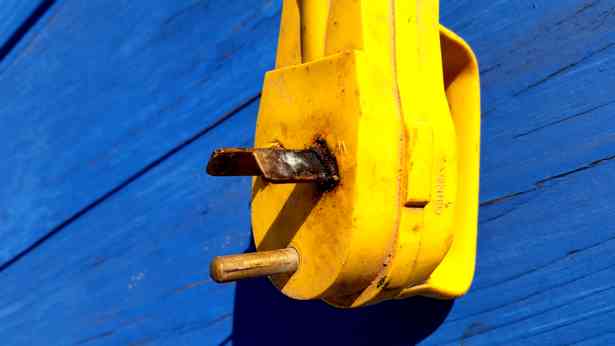
You can see how corroded one of the blades is. When it's corroded like this, it has a high resistance and that causes a lot of heat, especially under a heavy load. You can see where the yellow plastic was getting hot and starting to melt. Since I was running my air conditioners (oh, the joys of being in Florida in the winter time), the problem was getting worse by the day, but I didn't know it.
From now on, I'm going to check my power cord plugs once a month, even if I'm not next to the ocean.
Another connector problem
Since I started this article talking about contacts, I guess I should say another contact problem. Anyway, I came back to the North Carolina mountains in early April and I had to endure some cold weather that my bones were not used to. We even got some snow here in the mountains last night (April 16th).
To make a long story short, I needed my furnace to keep warm and it wouldn't work. I had not used it much in Florida and I didn't know that there was a problem with it. The furnace (and all of its electrical wiring) were 50 feet from the ocean all winter just like my electrical cord and guess what, one of the electrical connections wasn't making contact.
Cleaning an electrical connection is easy with a little sandpaper. The hard part is finding which one is not making contact. What you really need when hunting for a bad electrical contact is some good luck, and I just happen to have some. I started out with my multimeter to find why I wasn't getting 12 volts to the circuit board.
You can see that I have pulled the four connectors back just enough so I could get my multimeter prob to touch the blade. The good news is that as soon as I pulled the connector back on the blade marked "3" in the middle of the photo below, the furnace started working. That was the bad connection.
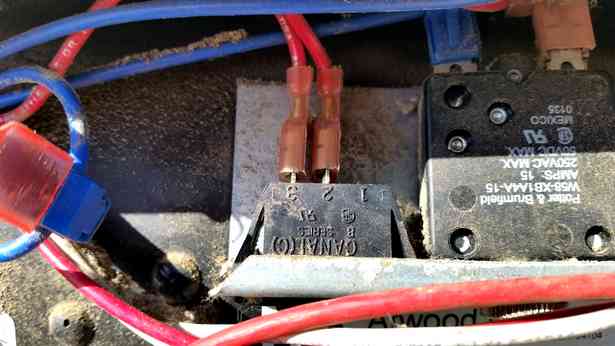
Even though that fixed the problem, I went ahead and cleaned all of the connections.
Thanks to me doing some checking (and a little luck in quickly finding the bad connection), I stayed toasty warm last night when it was snowing.
Note: If you're dealing with the contacts on a printed circuit board, a pencil eraser will do a good job of cleaning the contacts on the board. If you're dealing with larger connectors, fine sandpaper will do the job. Using a can of compressed air (like you use on your computer keyboard) will do a good job of getting rid of the dirt and dust on circuit boards and inside connectors. If you have connectors that you can't get to with sandpaper, you can pour a little vinegar into the connector and then dry it out with a can of compressed air. This usually works wonders.
There are commercial contact cleaners that work well too. One that I like is "Strike Hold" and you can get it at Amazon at this link: https://www.amazon.com/dp/B00BR3WY1W
Bottom line: Anytime you have a problem with something electrical on your RV, before you pay somebody $142 an hour to hunt for the problem, spend a little time removing all connections (one at a time so you don't get them mixed up). Inspect and clean each contact, and then proceed to the next one.