
RV Tires and Summer Heat
We all want to delay buying new tires as long as we can safely do it.
After all, RV tires are expensive, and when you buy six of them at one time it can knock a big hole in a budget. What some people do is take an envelope and put $100 a month in it for tires. In a few years when it's time to buy new tires, it won't hurt as much because, in a sense, your tires will already be paid for.
Here are some things to consider when trying to extend the life of your tires
1. A tire pressure monitoring system is one of the best investments you can make if you're an RVer. Have your rig weighed on all four corners. Check the tire pressure recommended by the manufacturer of your tires based on the weight of your rig. Note that the pressure should be checked when the tires are at ambient temperature. Also, the pressure should be the same for all tires on the same axle.
2. Tire covers will block UV light and extend the life your tires. A piece of plywood will help if you can't afford the tire covers.
3. In hot weather, back off of your speed a little. Driving 55 mph instead of 65 mph will greatly reduce the stress on your tires.
4. An under-inflated tire is a catastrophe waiting to happen, and it may not wait too long.
5. If your budget is tight (and whose budget isn't tight if you're an RVer), consider buying two new tires for the front, and buy the rear tires next year. A front tire blowout could be deadly (or at least, dangerous). A rear tire blowout would not be as bad since most RVs have dual tires on the back.
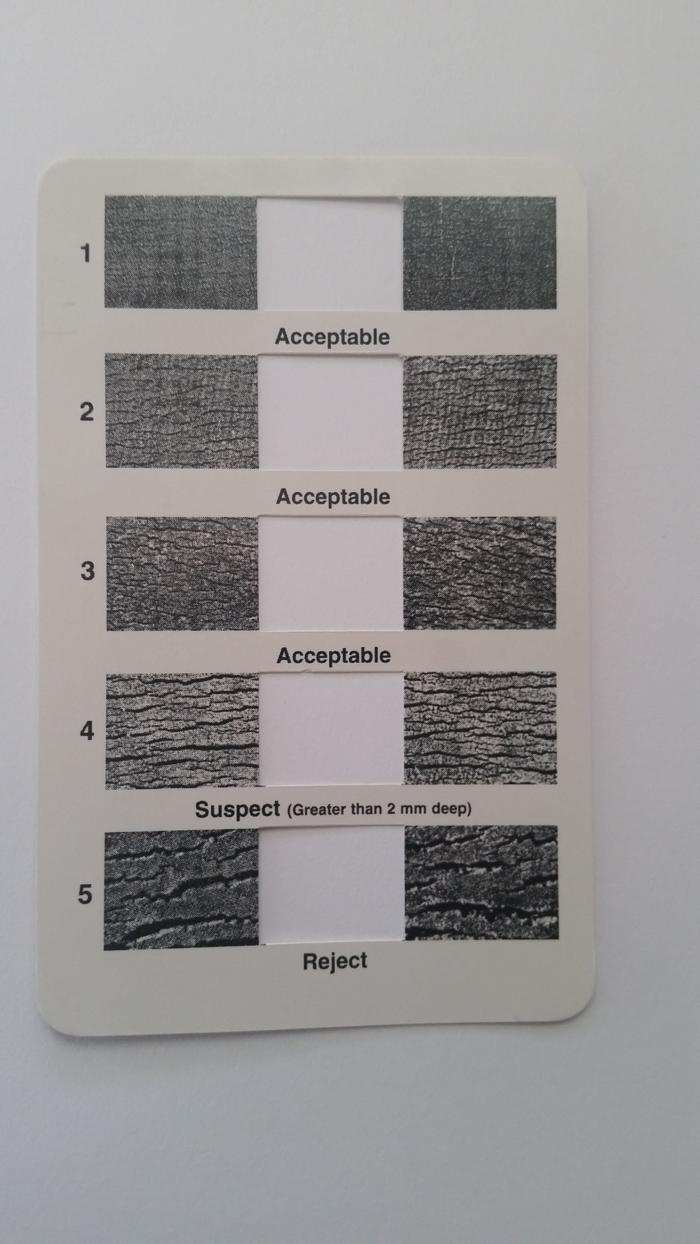
6. As a rule of thumb, RV tires are good for about seven years, but take this number with a grain of salt. Inspect your tires carefully, Michelin used to give away a card with pictures of different levels of cracks in tires. You could hold the card next to your tires and see how your tires compared. I have one of the cards that I guard with my life since they are no longer available. Below is a photo of the card. Basically, if the cracks in your tires are more than 2 mm deep your tires should be replaced. Two mm is .08 inches or a little over 1/16 of an inch.
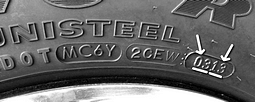
7. Know the date your tires were manufactured and know if you're pushing the limit on their life. RV tires age out. They don't wear out, so don't pay any attention to the tread unless you're driving a LOT of miles. The picture below shows the date code on a tire. The date code starts with DOT. Look at the last four digits. The first two numbers are the week and the last two are the year the tire was manufactured. In the picture below the tire was manufactured in the 3rd week of 2013.
8. RV tires can get 30 to 60 degrees Fahrenheit above ambient temperature. Since the maximum rated temperature for most tires is 156 degrees Fahrenheit and if the tire temperature increases by 60 degrees, that means that on a 95-degree day, your tire could be at 155 degrees. That's pushing the limit. Of course, most of the time your tires will not be getting a full 60 degrees hotter than ambient temperature, and also there is a safety factor built into these numbers. I think you can see that since tires get hotter when they are underinflated, only a slightly underinflated tire could spell real trouble. And by-the-way, metal conducts heat well and the temperature will more or less be uniform in a piece of metal, but rubber is not a good conductor of heat. This means that there can be hot spots in your tires.
If you have new tires, maybe you can push the limits some, but if you're trying to limp along and get one more year of life out your tires, pay very close attention to the eight points I've outlined above.
One last point: Contrary to what would come natural, if you have a blowout (maybe I should say WHEN you have a blowout since all RVers will probably have one sooner or later), you should press the gas pedal to the floor instead of stepping on the brake. Your RV won't really speed up any (it's not a sports car), but it will change the force and make it easier for you to maintain control. After you have your RV under control, let off of the gas and gently apply the brakes.
Bottom line: The two most important things you can do to make sure your RV tires are safe for summer driving is to check the date code and check the pressure. Low air pressure can destroy a tire in a very short time. Of course, driving a little slower can help too. If you're trying to get one more year's life out of your tires, by all means, follow the eight points outlined above.