
When should you buy new RV tires?
Tires are one of the most important (and most expensive) parts of RVing life.
No RVer wants to have a tire blowout while driving down the road, but also, no one wants to spend the thousands of dollars new tires can cost, at least, not until absolutely necessary.
The question we're all always faced with is when is it absolutely necessary to replace your tires. We all want to get as much life out of our tires as possible (and still be safe, of course). In order to accomplish this, I'm convinced that the best time to replace your tires is the day before you have a blowout. Okay, I'll get back to being serious.
You know exactly when you need to buy gasoline or diesel fuel. You don't have that clear deadline for when you need to buy new tires.
Also, the penalty for waiting too long to buy fuel is not nearly as bad as waiting too long to buy new tires.
Here is a chart that was published by Michelin showing when a tire should be replaced based on the cracks.
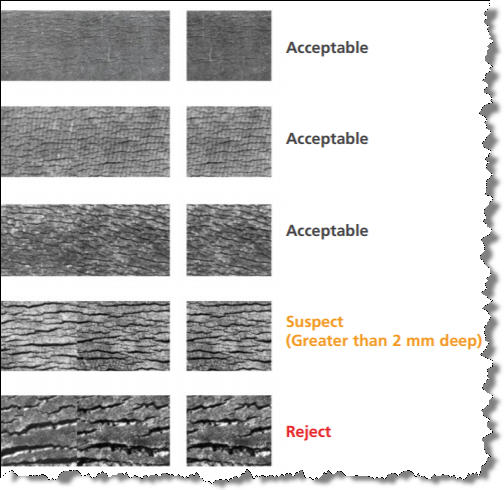
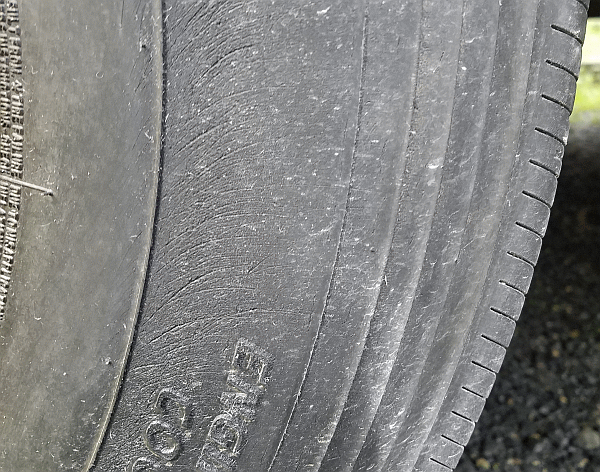
Below is a picture showing what my tires look like. You can see substantial scuff marks where I scraped against the curb, but there are almost no cracks at all, and based on the Michelin chart above, my tires are nowhere near needing to be replaced.
But there's something else to consider. Most tire experts recommend replacing RV tires when they're five to seven years old. My tires are eight and a half years old. So they are way past the age where they should be replaced.
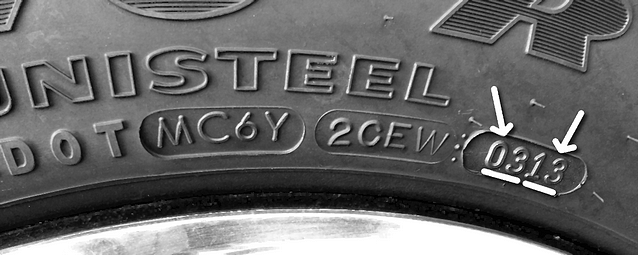
By-the-way, I've shown the picture below before in other articles, but I'm showing it here in case you missed it. This picture shows you how to find and read the date code on a tire. Just look for the series of letters and numbers that start with DOT and read the last four digits. The tire in this picture was manufactured in the 3rd week of 2013.
What would you do?
Would you go with how the tires look, and not buy new tires yet? Or would you go with the fact that the tires are way past the age when tire experts say they should be replaced?
There is another option you could consider. How about just buying two new front tires and then wait a year or two before replacing the rear tires? That would be a lot easier on the budget. After all, a blowout on a rear tire most likely wouldn't be as dangerous as a blowout on a front tire.
What did I do?
A set of six new Michelin tires would cost well over $3,000. After reading a lot of glowing reviews about Toyo RV tires on several of the RV Discussion Forums, I bought six new Toyo tires for $325 each including installation. With tax, it was slightly over $2,000.
Now hopefully, I can drive safely for the next five to seven years. I like the feeling of driving on new tires. If I had had a blowout while driving on my old tires, I would feel like, "How stupid could you be?" Now if I have a blowout with one of my new tires, at least, I can feel like I did all I could.
There are no guarantees
Even with new tires, there's no guarantee that I won't still experience a tire blowout. A friend of mine had a blowout that caused a lot of damage to his motorhome. His tires were only two years old.
Also, he had a tire monitoring system, and there was no indication of a problem until all of a sudden the tire blew out. He was driving between 60 and 65 mph. In other words, he was doing everything right. That's all you can do.
Bottom line: I hated to spend the money, but it sure does feel nice driving down the road with new tires.