What's it like to Live in Costa Rica?
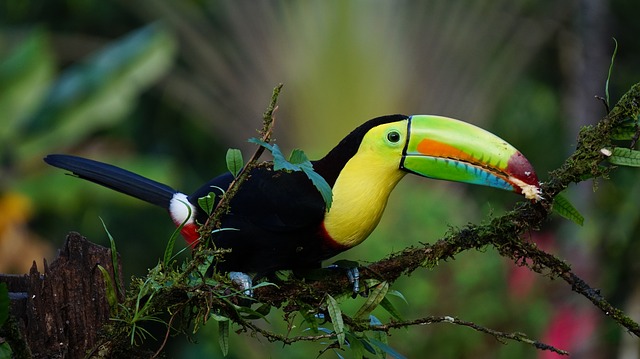
Some people say when they see a Toucan (like the one in the picture above), the first thing they think of is Costa Rica.
When I see this bird, the first thing I think of is a box of Fruit Loops™. The bird looks so artificial. It doesn't look real--that is until I look out the window of my apartment and see one sitting on my balcony staring back at me as if to say, "What are you doing here?"
Flowers, Birds, Fruit, and Veggies
There are lots of big, brightly colored birds in Costa Rica. They're very common. When it comes to flowers, I think everything here blooms. And there's fruit growing everywhere. In fact, there are mangos, coconuts, avocados, pineapples, bananas, papayas, and oranges all growing in the two-acre yard here where my apartment is.
There are all kinds of vegetables growing in Costa Rica too. I enjoy going to the huge farmer's market every Friday. Most of the farmers don't get to the farmer's market until about noon because they are in the fields picking their corps. A lot of the fruits and veggies you get at the farmer's market were growing in the fields earlier in the day. Talk about fresh produce, here it's really fresh.
Ordering Coffee Here is like Ordering a Pizza
You can call one of the local farmers and tell him what kind of coffee you want, and in a few minutes he will show up at your door (on a motorbike) with your bag of coffee.
I've been living in Costa Rica for two months and I have one more month before I head back to the U.S. You can only stay in Costa Rica for three months as a tourist before you have to leave the country. You can go across the border to Nicaragua or Panama and get your passport stamped and then stay another three months.
I didn't drive my motorhome down here. It's a long, long way to drive and I wouldn't want to try to drive my RV on these narrow, crooked roads here anyway. I put my motorhome in storage for $30 a month and canceled the collision insurance for three months, and that saves me $130 a month. That means I'm saving $100 a month while I'm here.
Beaches in Costa Rica
Most people picture beautiful beaches when they think of Costa Rica, but I'm up in the mountains at about 4,500 feet. I'm three hours from a beach.
The trouble with beaches is that they are all at sea level (what a surprise) and it's hot if you get off the mountain and go down to sea level. It's about 20 degrees warmer when I go off the mountain to the beach. I guess that's why the coffee is grown on the mountains where it's cool and not near the beaches.
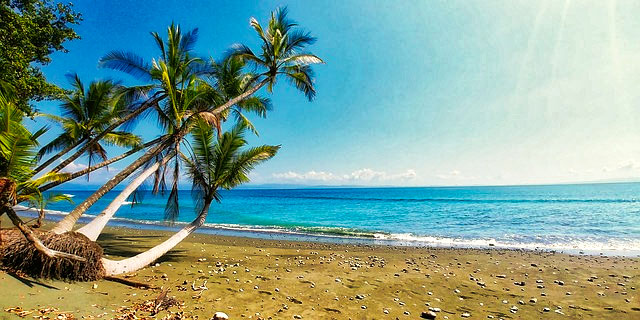
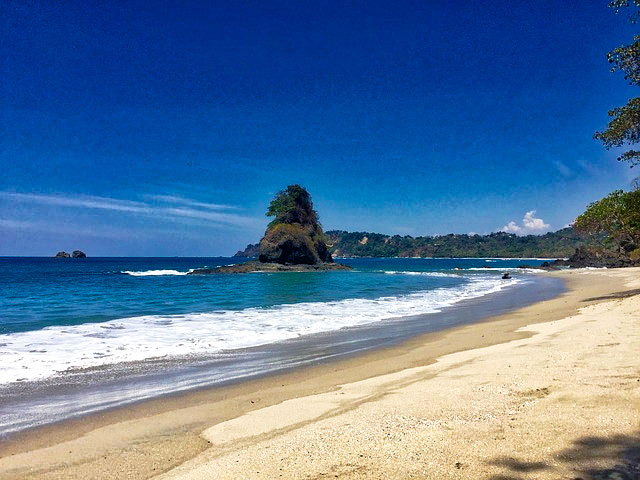
It's nice to visit the beaches but I wouldn't want to live there. Since this area is so close to the equator, I guess I should expect it to be hot at sea level. The ocean breeze helps (if it's blowing in the right direction). Most of the beaches here are small. With a little effort, you can have your own private beach. (Until somebody else finds it too.) Below are two typical beaches.
The RV Lifestyle Gives Me Flexibility
I like to spend five months in the NC mountains, three months in Florida, and four months in Costa Rica. As I said before, if you stay in Costa Rica for more than three months you have to leave the country and get your passport stamped to prove that you actually left and came back. That's not a big deal.
Living in an RV gives me this flexibility and it's a low-cost way to live. Staying in Florida during the winter months when all of the other snowbirds are there gets expensive, but living in the NC mountains is reasonable and living in Costa Rica is very inexpensive. I like and look forward to different places.
When I'm in the U.S., I take side trips in my motorhome, but Florida and North Carolina are where I spend most of my time. Sometimes I'm in different parts of Florida and North Carolina.
Driving in Costa Rica
I don't want to drive in Costa Rica. The roads are crooked and narrow. Pedestrians don't have the right of way. I think this is where New York sends their taxi drivers to train them how to drive in New York City.
The good news is that I don't have to drive. They have new Mercedes buses that run every 30 minutes and they are cheap. I think it cost me about 75 cents to take a bus to town. It's about a 30-minute bus ride or 15 minutes in a car. They don't have school buses here. The kids ride the regular buses, so during the week, the buses make a lot of stops picking up kids.
Unusual, but Effective Ways of Doing Things
- Schools: All kids wear school uniforms. The kids go to school for four hours a day. Part of them attend school from 8:00 a.m. to 12 noon. The teachers get a lunch break from 12:00 until 1:00, and then another group of kids go to school from 1:00 until 5:00. That way the teachers work eight hours a day and the school building is used all day.
- Fire department: They have regular size fire engines here, but they are seldom used. First of all, nothing is built using wood. Everything is built using concrete and iron. There is not much in a house that can burn. When there is a fire, a fireman shows up on a motorbike with a firehose in a special backpack. There are fire hydrants everywhere. A fireman on a motorbike can get somewhere a lot faster than a large fire truck.
- Medical: If you have a minor illness, you can go to a pharmacy and the pharmacist can examine you and listen to what you have to say. Then he can give you a shot or give you a bottle of pills (or both). All of this is very inexpensive.
Bottom line: A lot of things in Costa Rica are not necessarily good or bad, they're just different. You have to adjust to things moving slowly (except cars). People here don't get in a rush, and they don't pay any attention to a schedule or time. But I've seen several articles saying that Ticos (that's what people here call themselves) are the happiest people in the world. I believe it. They are very friendly, and they just don't worry.
If you didn't see my article three weeks ago about living in Costa Rica, below is a link to it.