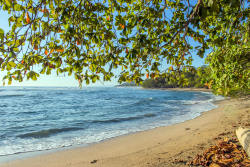
A typical beach in Costa Rica
Is it cheaper to live in Costa Rica?
Living in any foreign country is an adventure.
It can be much cheaper to live in countries other than the US, but there are other things to consider.
I live in Costa Rica, and I spend about half as much living here as I spent when I lived in the US.
I could go south to Panama, and it's less expensive there. Or I could go north to Nicaragua, and the cost of living would be even less. I've been to both places multiple times, and I like it better here in Costa Rica.
Costa Rica isn't a place you visit—it's a place you feel
You can spend as much living here as in the US. It all depends on where and how you live. Some things here cost a lot less than in the US, and some things cost more. In short, if Costa Rica produces or grows something, it's much cheaper here, but if the US (or most other countries) produces it, you can expect to pay more and sometimes a lot more.
For example, cars here are at least 50% more expensive than in the US, and gas is more expensive here than in the US. If you want to bring your car, besides the shipping cost, there are huge import duties on any car you bring into Costa Rica. It's usually cheaper to buy a car here.
Or better yet, get by without a car. That's what I do. A bus comes by every hour, all day long, from 4:00 a.m. until 10:00 p.m. And during the busy time of the morning, the bus comes by every 30 minutes. A bus ride down the mountain to town costs about $1.00. Residents over 65 can ride the bus for free, but I haven't applied for residency yet. Uber is popular here also, and rides are reasonable.
The three areas where I save the most money are food, housing, and transportation. Since almost everything grows here year-round, I buy most of my food at the local farmer's market. They pick strawberries, tomatoes, and most other vegetables every day of the year here.
You can usually get everything at a large grocery store, but the prices are higher, and the food is fresher and of better quality if you buy from the farmer's market or local shops.
I buy meat at a butcher shop, bread at one of the many bakeries, and cheese at a cheese shop. It takes more time to visit all these different shops, but people here don't rush or get in a hurry. When I go to the farmer's market, it's a social event. I see almost everybody I know while I'm there.
The vendors are all friendly and generous. Many times when I buy tomatoes, mangoes, etc., the vendor weighs what I bought; I pay him, and then he puts some extra items in my bag at no charge.
Housing is inexpensive here
You can rent nice, one or two-bedroom homes or apartments for $400 to $600 a month, and that usually includes electricity, high-speed fiber-optic Wi-Fi, and cable TV.
I live in a new house that was built last year. Up here on the mountain, where I live at 4,500 feet elevation, none of the houses have any heat or air conditioning. It's unnecessary. The temperature is almost always in the mid-70s day and night every day of the year. Of course, air conditioning is necessary when you get down to sea level at the beaches, where the temperature gets into the 90s. (Note: I've found that the beaches here are all at sea level.)
Medical expenses are low here
Many people travel here to receive low-cost medical and dental care. There is private health care here, and you qualify for the free government-run health care after you become a resident (which takes about $1,500 and a year or so). With this system, you get free medical care, including hospital stays, doctor visits, and all medications, for a monthly fee of about 7% of your Social Security income.
Once, I was feeling under the weather, and I went into a local pharmacy. The pharmacist walked me back to a room, listened to me describe my symptoms, checked my vital signs, gave me a shot, and some pills. The total cost was $7.00 US, and I felt fine the next day.
Once, I went to see a private doctor here. I didn't have an appointment. I just walked in, and I didn't even sit down in the waiting room. The doctor saw me immediately.
Not everything here is wonderful
Nobody gets in a hurry, and it takes forever to get anything done. I'm not usually trying to get anything done, so it's no problem for me. I don't do any banking here except to withdraw cash from an ATM that's outside in the lobby. The only thing I use cash for is at the farmer's market.
If you go into a bank for any reason, plan on being there for at least an hour, and two hours is not uncommon. And many times, it takes two to three visits to get almost anything done except exchange currency.
The roads here have a lot of potholes. My landlord used to live outside of Dallas. He said he had to drive about 100 yards down a gravel road to get to his house, and his property taxes were $9,600 a year. Here, there's a paved road in front of his house. The road has potholes, but his property taxes here are only $300 a year. He said he would rather have potholes than high taxes.
You also have to deal with what's called Tico-time. The locals are called Ticos. If someone says they will show up at 9:00 a.m., don't expect to see them at 9:00. They may not even show up that day. That's called Tico-time.
Bottom line: Life here or in almost any foreign country will be an adventure. Don't expect things to be done as they were back home. But the good news is that I can live a very comfortable life here on just my Social Security income and still add to my savings every month. As a bonus, the people are extremely friendly, the food is fresh and delicious, and the weather is wonderful year-round. I love my life here.