
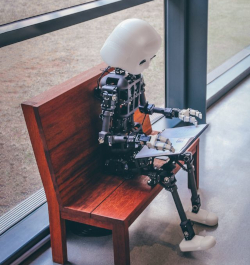
What is the world coming to?
How Wrong Can AI Be?
Lately, I've been playing with Artificial Intelligence, or AI as it's commonly known.
It surprises me how wrong AI can be in some situations.
Speaking of AI, should I refer to AI as "it" or "they"?
If I want to know something, I could ask AI, so I did. Here's how AI answered that question:
Treat AI as an inanimate object.
That would mean referring to AI as "it." That makes sense, but when dealing with AI, it's easy to feel you're interacting with a person or a group of people.
I would expect that when it comes to opinions and writing fiction, AI might go off in left field at times, but when dealing with facts that are easy to verify or look up, AI should almost always be correct.
But that's not true.
Examples where AI was dead wrong
- In an article about restaurants, AI provided an example of a restaurant marking up food by 300% and stated that they should report them to the IRS. In any business, the business owner can mark up the item they're selling by 1,000% if they want to. There's nothing illegal about it. And by the way, it's common practice in most restaurants to mark up food by 300%. Any time the cost of food for a restaurant is more than about 30% to 33%, the restaurant is close to not being profitable and may not be around long.
- On a five-hour flight, AI talked about having to deal with jet lag. That would be true on an east-to-west flight. But when a person was flying north to south in the same time zone, jet lag would not be an issue.
- It's easy to look up grammar rules, so you would think AI could do an excellent job of detecting and correcting grammar, punctuation, and spelling mistakes, but don't count on it. I've found that AI makes a lot of mistakes when asked to do this for an article.
- I live four miles from a volcano here in Costa Rica. People can walk up to the fence and look over into the volcano and see the steam coming out of it. One time last year, the viewing area was closed, and when someone asked AI why, AI said it was because of the danger that the volcano might erupt. That was a good guess, but it was dead wrong. The reason the viewing area was closed for a few days was because they were replacing a bridge on the trail to the viewing area.
I don't like AI, and I wish it would go away, but that's not going to happen, so I'm trying to learn what AI is good at and what AI is not good at.
I've found that AI is good at creating and modifying images, but not so good when dealing with text.
AI is getting better. Recently, when I was creating or modifying an image and I told AI what size to make the image, AI would ignore that statement, and I would have to use GIMP to resize it. But the newer versions of AI produce images to match the size specified.
There's a phrase that describes this when talking about books and articles created by AI. They are called "AI slop." And in a lot of cases, that's a true description.
A while back, Amazon changed its rules to allow people (I won't call them authors) to publish only three books a day. Amazon changed the rules again recently and now allows someone to publish a maximum of ten books per week.
When publishing a book, Amazon requests that authors state if they used AI for text or images and to name the program. Amazon doesn't reveal this information to the reader or customer, but if you're not truthful when answering this question, Amazon can terminate your account, and they have done so.
Bottom line: AI is a tool, and like all tools, learn how to use it and recognize its limitations to get the most out of it.